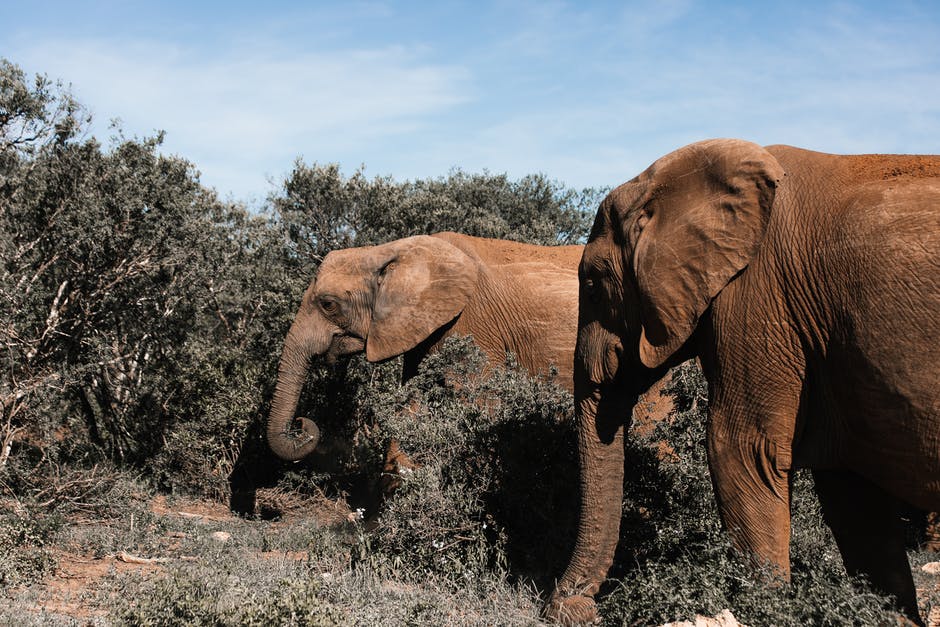
According to a study in Science Advances, the possibility that the world’s most diverse ecosystems will be impacted by the loss of large herbivores is increasing. The latest research was conducted by William Ripple (respected professor at Oregon State University’s College of Forestry). Large herbivores are those that weigh more than 100 kgs lbs). Professor Ripple, along with colleagues from Australia, the UK, South Africa and South Africa conducted a detailed analysis of the data about the most large herbivores in the world, including their endangerment status and key threats. They also examined the environmental consequences associated with dwindling numbers. Source: advances.sciencemag.org. According to them, the population of elephants, rhinoceroses, camels (and many smaller ones) is in decline or at risk in deserts, grasslands, forests and savannahs. Professor Ripple’s team focused on seventy four large herbivores and found that they are disappearing from many regions without radical intervention. This was in addition to a study Prof. Ripple had previously led on large-carnivore loss. According to Prof. Ripple, large-carnivore numbers are closely linked with their herbivore prey. Habitat change and hunting Prof. Ripple stated: “I assumed that habitat loss would cause the decline in large herbivores. Surprisingly, habitat change and hunting are the main causes of herbivore declines. These are two threats. The research refers to an article on the decline in animal population in tropical forests, published in BioScience in 1992.. Kent H. Redford was at that time a postdoctoral researcher at University of Florida. He first created the term “Empty Forest”. Redford stated that while there may be other forms of plant life, such as soaring trees, it was not a threat to the ecosystems. However, Redford said that forest fauna poses a grave, long-term risk. Source: advances.sciencemag.org. Professor Ripple, along with co-researchers, went further in this research. They said that their analysis showed it extends well beyond forests to include grasslands, deserts, and savannahs. The Empty Landscape is a term we invented. Terrestrial herbivores can be found on every continent, except Antarctica. They are a diverse group that includes approximately 4 ,000 species. According to the authors, large herbivores that are at risk of extinction live in countries with low incomes, such as India, Africa and Southeast Asia. The European bison is the only large herbivore in Europe that has been declared endangered. North America has none, and North America is the only place where there are any. Twenty-five of America’s largest wild herbivores now occupy 19% on average. The global competition for livestock has increased by three times since 1980,. This has resulted in a decrease in herbivores’ access to water and forage, as well as increased disease transmission risk. The European Bison is the largest threatened large wild herbivore. According to the authors, global meat trade and animal parts trading fuels the hunting of herbivores. Today, approximately 1 billion people rely on wild meat. Professor Ripple stated that the market for rhino horn, which is used for medical purposes, can be extremely strong. The price of Horn is higher than that of gold, diamonds and cocaine. In 2011, Africa the western black rhinoceros has been declared extinct. Tall levi (co-author), who is an Oregon State University professor in Fisheries and Wildlife, stated that the reasons for the decline in large herbivore numbers “are hard to fix in a world of increasing human population and consumption.” He added, “But it’s impossible that we allow the demand for horns and the use of tusks drive the extermination of large herbivores out of otherwise suitable habitats. Researchers wrote that if large herbivore numbers are declining, then it likely means other wild ecosystems will be affected. These likely effects include a decrease in food resources for large carnivores like tigers and lions as well as reduced seed dispersal, slower cycle of nutrients from soil to plants and habitat changes for small animals, such as amphibians, birds and fish. Professor Ripple stated that the report will increase awareness of the role of large herbivores within these ecosystems. We hope policymakers will take steps to preserve these species.” A coordinated effort is required to better understand the potential consequences of large herbivore loss. The researchers recommend coordinating research efforts that focus on endangered species from developing countries. They stressed that the local community must be involved in solving large herbivore populations declines. According to the authors, “It’s essential that local communities be involved and gain from the management of protected area.” Participation of local communities in management of protected area is strongly correlated with compliance of protected area policies.” Citation. “Collapse among the world’s biggest herbivores”, William J. Ripple and Thomas M. Newsome. Science Advances Vol. 1 no. 4 e1400103. Published May 1, 2015. DOI: 10.1126/sciadv. 1400103.
A large herbivore decrease may cause an “empty landscape”