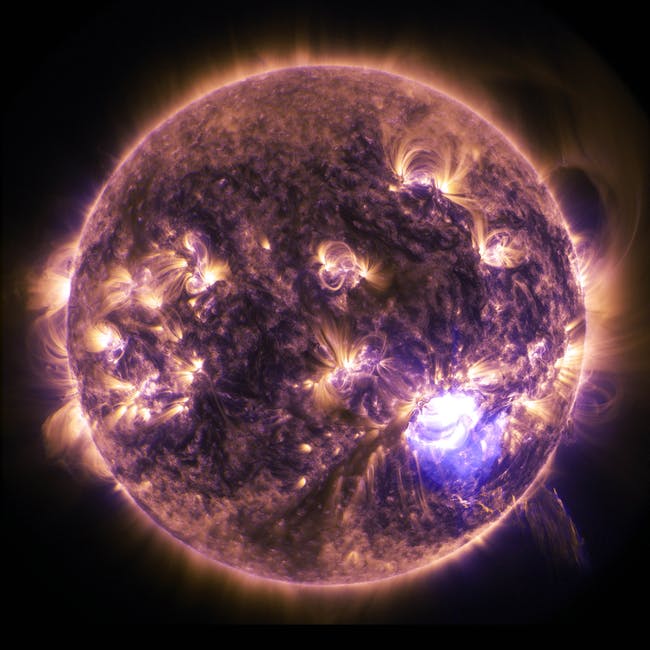
According to NASA’s Mars Atmosphere & Volatile Evolution mission (MAVEN), Mars was stripped of its thick atmosphere. Mars, once warm and moist (an environment that could have sustained life as we know) is now cold and dry. Scientists have been able to use MAVEN data to determine how quickly Mars’ current atmosphere is being eroded into space by solar wind. The continuous stream of charged particles (mainly protons and electrons) that flows from the Sun through the solar system is called the Solar Wind. They travel approximately 1 million miles an hour. Artist’s rendition of the solar storm that struck Mars, removing ions from its upper atmosphere. The atmosphere of the Red Planet would have remained intact if it had an Earth-like global magnetic field. Image: mars.nasa.gov. Ions are shot into space by the solar wind. It can flow past Mars and generate an electrical field that accelerates the electricly charged atoms in the upper atmosphere. This then propels them into space. Mars has no global magnetic field that can deflect the stream of charged particles blowing off the Sun, unlike Earth. Data showed Mars’ atmosphere is more susceptible to solar storms. Their findings were published in Geophysical Research Letters (peer-reviewed academic journal) and Science. John Grunsfeld (an astronaut) said that Mars had an atmosphere thick enough to sustain liquid water, which was a crucial ingredient for living things as we know them. Our knowledge about the evolution and dynamics of any planet’s atmosphere can be improved by understanding what happened to Mars’ atmosphere.” NASA’s Mars Atmosphere & Volatile Evolution (MAVEN), spacecraft orbiting Mars has been around the red planet since September 2014.. MAVEN data shows that solar wind strips away approximately 100 g (about one-quarter of a pound per second) of gas. MAVEN chief investigator Bruce Jakosky at University of Colorado Boulder said that gas loss has been greater in the past. “Like the theft of coins every day from cash registers, it becomes substantial over time. As we’ve observed, atmospheric erosion is more severe during solar storms. Therefore, the rate of loss was higher in the past billions of year when the sun was younger and more active. In March 2015., a series of strong solar storms impacted Mars’ atmosphere. MAVEN data shows that gas was “shot” into space much more quickly during this period. According to the authors, the Martian climate was dramatically altered by the faster loss rates combined with more frequent solar storms. MAVEN monitors solar wind and ultraviolet radiation to determine how these remove gas from the Red Planet’s top. What would Mars look like today if it had lost its majority of its atmosphere? The atmosphere would have been humid, warm and moist with abundant life. Three regions experience atmospheric loss. The most recent results indicate that there are three areas where the atmosphere has been lost: The ‘tail,’ where the sun’s energy flows behind Mars. 2. In a “polar plume”, above the south and north poles of Mars. 3. Researchers determined that almost 75% escaping ions came from Mars’ tail region. A small percentage of them also come from Mars’ plume and extended clouds. Mars used to have lots of water. Some evidence suggests that Mars had once been flooded with water. Some features found in Mars’s ancient areas resemble valleys that were created by rivers or mineral deposits. These formations could not have been possible without liquid water. Researchers believe these features indicate that Mars’ atmosphere existed billions of years before it is now. Researchers believe that the Red Planet may have had rivers and lakes. NASA’s Mars Reconnaissance Orbiter spotted hydrated salts appearing in the Mars season earlier this year. This suggests that Mars may have briny liquid water. Unfortunately, Mars’s current atmosphere is too cold and thin to sustain large quantities of liquid water. Joe Grebowsky from NASA’s Goddard Space Flight Center, Greenbelt (Maryland) said that solar-wind erosion was an important mechanism of atmospheric loss and could account for substantial changes in Martian climate. MAVEN is also studying loss mechanisms such as the escape of hydrogenatoms or impact of ions. This mission was launched on November 2013, and aims to find out how much Mars’ atmosphere has ended up in space. Video: Solar wind strips Marian atmosphere Mars today is cold and dry, however researchers believe that it was warmer and more humid billions of year ago. This dramatic shift may be due to the loss of Martian’s early atmosphere, which is one reason why the solar wind might have been a prime suspect.
NASA: Solar wind has stripped Mars’ atmosphere