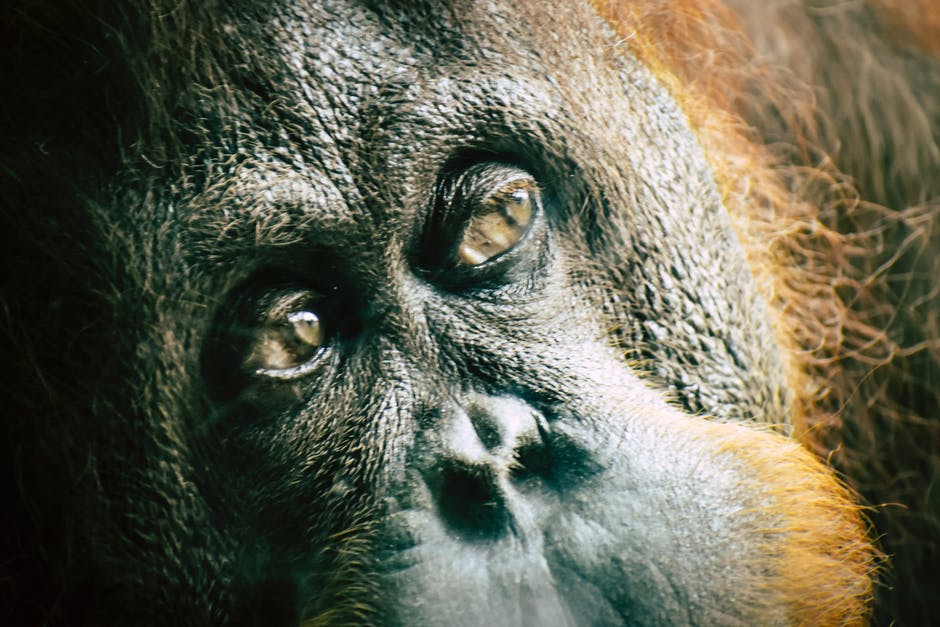
Orangutan numbers in Indonesia have fallen alarmingly due to their habitats being literally burned to the ground. International Animal Rescue is a charity which saves animals suffering around the globe. As huge swathes of Indonesia’s forests are being destroyed by forest fires, these apes need our support. LAPAN, the Indonesian National Space and Aviation Agency reported that more than two million hectares have been completely destroyed in just a few months. The effects of recent fires on Indonesia’s rainforests, where once flourished large numbers of orangutans, are still unknown. This is what scientists in Indonesia know: If a headcount can be done, the numbers of orangutans will drop to a depressingly low level. Orangutan population was already rapidly declining before the recent forest fires. Argitoe, Field Manager and his colleague rescue an orangutan who is being given fluids by drip. (Image: www.internationalanimalrescue.org) Damage caused by the fires can be observed in several places across Kalimantan. In the Community Forest of Pematang Gadung – a peat swamp forest covering 21,000 hectares with an incredibly rich biodiversity and a dense population of orangutans – fire damage has been extensive. International Animal Rescue (IAR), a UK-based organization that helps orangutans, was shocked by the extent of fire damage to their unique habitat. The members of the IAR Indonesia have seen firsthand how this habitat has been destroyed. Karmele Sanchez, IAR Indonesia’s Programme Director, stated that there are not enough words to describe how deeply we feel. When fires strike in an instant, all our efforts to save orangutans’ habitat and habitat will be in vain. We are determined to save the forest and its biodiversity, as well as the important peat swamp ecosystem. IAR Indonesia worked hard over the last three years to establish an ecotourism project in this rainforest. It also collaborated with local communities in order to reduce carbon emissions and provide income. IAR Indonesia has been attempting to save the orangutans in burnt forests 24 for several months. Everyday, baby orangutans are dragged to the rescue center. They are lucky, and they will live. (Image: www.internationalanimalrescue.org) Tantyo Bangun, Chairman of IAR Indonesia, said regarding their rescue efforts: “Thus far our Rescue Team has rescued more than 20 orangutans from burnt forest and we are still rescuing more. Worse, we do not know the number of orangutans that died before we could rescue them. The HOC team (Human Orangutan Conflict), which is part IAR is currently monitoring the situation of orangutans affected by wildfires. Because the fires literally decimated everything in their area, they are now suffering long-term hunger and severe malnutrition. The tiny, starving mother and her baby are clinging on to her. (Image: www.internationalanimalrescue.org) The HOC workers track down, capture and translocate orangutans that are unable to survive without human intervention. Local residents assist them by raising the alarm when they see an orangutan that is in need of assistance. Gail Campbell Smith, IAR Indonesia’s Programme Manager, stated: “The most saddest picture you can imagine is a majestic orangutan who should have been travelling in the canopy, but instead drags itself onto the ground and struggles to find a tree that will make it a home.” The Paris Climate Talks, which are currently underway, are ongoing. Representatives from 180 nations and leaders have met to discuss an international agreement that will reduce carbon emissions, and slow down climate change. Climate change and more forest fires. Vice versa. Climate change has led to increased forest fires in Indonesia. This problem has been exacerbated by an extended dry season caused by ENSO (El Nino Southern Oscillation). The world was shocked by this heartbreaking photograph of Mama Anti with her infant. (Image: www.internationalanimalrescue.org) These forest fires emit colossal quantities of greenhouse gases, which significantly aggravate the effects of climate change, and seriously damage human health. The 1997 fires, which were similar to this year’s, resulted in approximately 20 million people suffering from respiratory problems, and between 19,800 and 48,100 premature deaths. These fires were emitted in 1997, between 0. 81 to 2. 57 gig tons of carbon. El Nino’s effects are expected to persist until the spring 2016.. BMKG (Indonesian Institute for Meteorology, Climatology and Geophysics), expects another severe drought in the next year. The forest fires have been stopped by the delayed monsoon. It is alarming to think that the same thing could happen next year. Bangun stated that if preventive measures don’t take place, and funds aren’t invested in fire prevention and prosecutions against those who started the fires, then this ecological catastrophe (already considered one of the most devastating ecological disasters of our century) may return next year. Sanchez said, “We still have to deal with the devastation caused by the previous fires, and our team works hard to save as many as possible.” We now need to work to restore the forests and forest. Mothers and their babies, who cling to them for life, are the most striking of all the animals that were rescued. The heartbreaking photo of Mama Anti with her baby was taken just weeks ago and has been shared by millions around the globe. As heartbreaking as the photos of Noval and Mama Novia who were part of the most recent rescues are, Sanches said: “This isn’t very different from the devastating effects of war, and it should be treated as a global crime.” There are some positive news reports about IAR. The team was proud to celebrate the release last week of six orangutans from Gunung Palung National Park, West Kalimantan. The four-hour journey to the release location was completed by fifteen IAR team members and twenty-five locals. Transporting a caged animal by foot took four hours to reach Gunung Palung National Park, West Kalimantan where it will be released. (Image: www.internationalanimalrescue.org) The physical effort was worth it, they all said. One.
Orangutan population plummets as habitats are destroyed