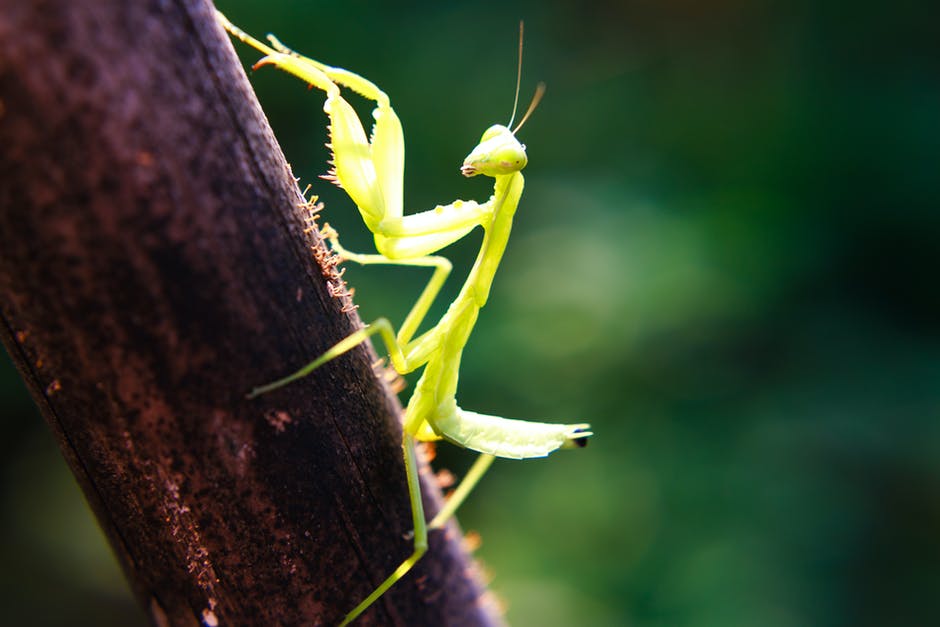
. The praying mantis has total control and precise landings. This study was published in Current Biology, citations below. High speed videos revealed that juvenile praying mantises, unlike small jumping insects like other species, do not spin out-of-control in the air. It is more difficult to keep your balance when jumping into the air if you are smaller than you should be. Small errors in propulsive force relative the centre of mass can cause grasshoppers, leaveshoppers and other jumping insect to spin uncontrollably through a jump. The balance of twists and turns is achieved by leap mantises. Scientists had previously hypothesized that small insects could not control their movement and would spin unpredictably with frequent landings. The researchers examined a number of videos of juvenile praying mantises that were wingless. They discovered that they actually use the spinning motion to allow them to leap accurately and reposition their bodies midair to hit their landing spots. This happens in less than a tenth of an second. Amazing precision was displayed by the mantises as they jumped from a rod. Researchers held a distance and the mantises were seated on a platform. The praying mantises spun their bodies in a variety of directions while jumping. They rotated their abdomen and legs simultaneously, but in different clockwise and anticlockwise directions. They were able to align themselves perfectly with the landing area by using their body movements. This was done in less than the time it took for a human eye blink to see – in 80 seconds (0. 08 of one second. Scientists initially wondered if the mantis was simply trying to reduce the spin caused by small insects jumping at high speeds. Mantis controls spin. When the scientists studied slow-motion video of the jump, they discovered that the mantis controlled the spin during its takeoff and landing. Research team examined 281 slow motion videos of 58 young praying mantises leaping to their target. The intricate mechanisms used by insects to land on the target spot every single time were discovered. A praying mantis jump takes 0. 08 seconds from takeoff to landing. Image Credit: Professor Malcolm Burrows (University of Cambridge). Author: Dr Gregory Sutton, from Bristol University, conducted the research. “As far we know, these insects control every step of the leap. The landing spot is not uncontrolled and there isn’t compensation. This is the way we thought. Dr. Sutton stated that the mantis generates angular momentum when it takes off and distributes it while it is in mid-air. A certain amount in one’s front leg and a smaller amount in another, which stabilise and shift the body’s orientation. The researchers also glued sections of the abdomen to show what the consequences would be if the spin was not controlled. It was expected to lose control. It was amazing to see that it did not lose its ability to jump accurately. The researchers were still able reach the target but couldn’t rotate their bodies in the correct position. They crashed into the landing area and bounced off. Researchers want to know how mantis can perform its incredible mid-air aerial acrobatics in such high altitudes. Professor Burrows stated that “we can see the mantis performing a scanning motion with its head prior to a jump. It is able to predict everything ahead of time or make quick corrections as it moves through the jump. The answer to these extreme possibilities is not known.” Dr. Sutton says, “We now have an excellent understanding of the biomechanics and physics of precise aerial acrobatics. Because the movements of these robots are quick, it is important to know how the brain controls them once they are in motion. Dr. Sutton thinks robotics researchers can learn from young praying mantises. Small robots can fly, but walking takes too much energy. Although jumping makes sense, controlling the spin of jump robots can be difficult. He said that the juvenile mantis was a good example of how a machine could be used to solve this problem. Citation: “Mantises exchange angular momentum between three rotating body parts to jump precisely to targets,” Malcolm Burrows and Darron A.Cullen. Marina Dorosenko, Gregory P. Sutton. Current Biology. DOI: http://dx.doi.org/10.1016/j.cub.2015.01.054. Video: Praying Mantis Acrobatics
Researchers from Bristol and Cambridge discovered that praying mantis leaps at incredible speed and precision