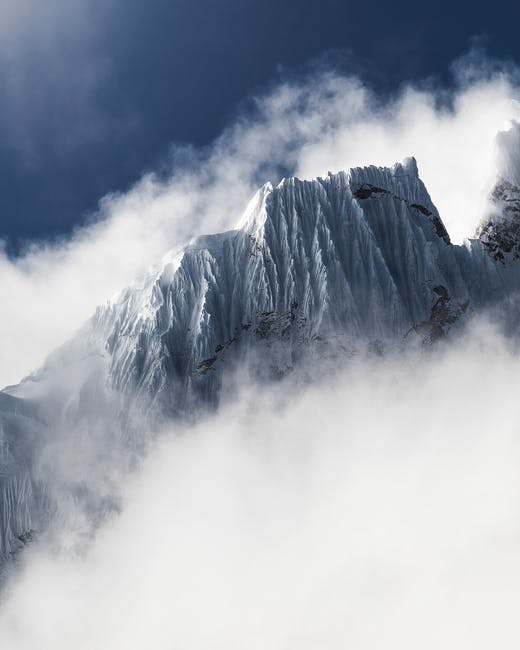
A team of French, Nepalese and Dutch scientists believes that unless drastic measures are taken, the majority of Everest’s glaciers will vanish by the middle of this century. The team estimates that there will be a decrease in the glacier volume between 70% to 99% during the year 2100.. Scientists wrote that dramatic changes in glacier volume in Everest, Himalayas are likely to occur if greenhouse gas emissions continue to rise. Joseph Shea (a glacier hydrologist from the International Centre for Integrated Mountain Development in Kathmandu) and his colleagues discovered that Everest’s glaciers will be very sensitive to any future warming. One scientist takes measurements in the Mera glacier region of Dudh Kosi’s basin. (Image: Eurekalert. Credit to Patrick Wagnon. Dr. Shea stated that glacier mass loss is most likely. He used a model developed by her and others. The extent of the loss depends on whether greenhouse gas emissions are increasing. Dr. Shea stated that the glaciers could be sensitive to temperature changes and precipitation increases. Higher temperatures will accelerate snow melt and increase precipitation at glacier-rich altitudes. A double whammy: Rain and warmth combined will cause glaciers to melt more quickly and shrink in volume. High Mountain Asia is the region with the highest volume of ice, outside of the polar areas. Researchers studied the glaciers of the Dudh Kosi Basin in Nepal Himalaya. This includes Mt. Everest and other high-mountain peaks were also studied by the scientists. This study included more than 400 kilometres of glacier surface. Dr. Shea stated that, “Apartfrom the importance of the area, glaciers within the Dudh Kosi Basin contribute meltwater into the Kosi River and glacier changes to river flows downstream” Alterations in glacier volume can affect the availability of water, which could have consequences for hydropower generation as well as agriculture. Although more glacier melt increases water flow initially, continued retreat leads to less meltwater from glaciers in the warm months. This is the most significant impact on local communities before the monsoon when water is limited. Glacier debris dams can cause more lakes as a result of reduced glacier volume. The dams may be broken by earthquakes or avalanches. This can lead to devastating flooding with rivers running at 100 twice their usual rates in the Kosi Basin. The scientists used field observations as well data from nearby weather stations to test and calibrate a model of glacier changes over the past five decades. Walter Immerzeel from Utrecht University, Netherlands is co-author. He said that the scientists used historical data, field observations, and meteorological data to determine how the glacier volumes and areas responded to climate change. Dr. Immerzeel stated that the freezing level is currently 3200 in January, and (*] m in august. Based on historical temperature measurements and projected warming to the year 2100, this could increase by 800-1200m.” “Such an increase would not only reduce snow accumulations over the glaciers, but would also expose over 90% of the current glacierized area to melt in the warmer months.” Study just an initial approximation However, the authors caution that their results should be viewed as a first estimate to how Himalayan glaciers will react to rising temperatures in the region. Patrick Wagnon is a French glaciologist and visiting scientist at ICIMOD. He said that even under the best climate change scenarios, glacier changes will occur in this region. Citation: “Modelling glacier changes in Everest, Nepal Himalaya”, J. M. Shea and W. W. Immerzeel. P. Wagnon. C. Vincent. And S. Bajracharya. The Cryosphere. Published 27 May 2015. DOI: 10. 5194/tc-9-1105-2015.
The Everest glaciers are likely to disappear by the middle of this century.